


Ambisonics Set in Binaural
Written Commentary
Sotheby’s is one of the largest brokers of art collections. Although it holds auction exhibitions every year, however, ordinary people barely have access to it: once in Asia, only the cities of Hong Kong and Singapore are the qualified locations to hold such events.
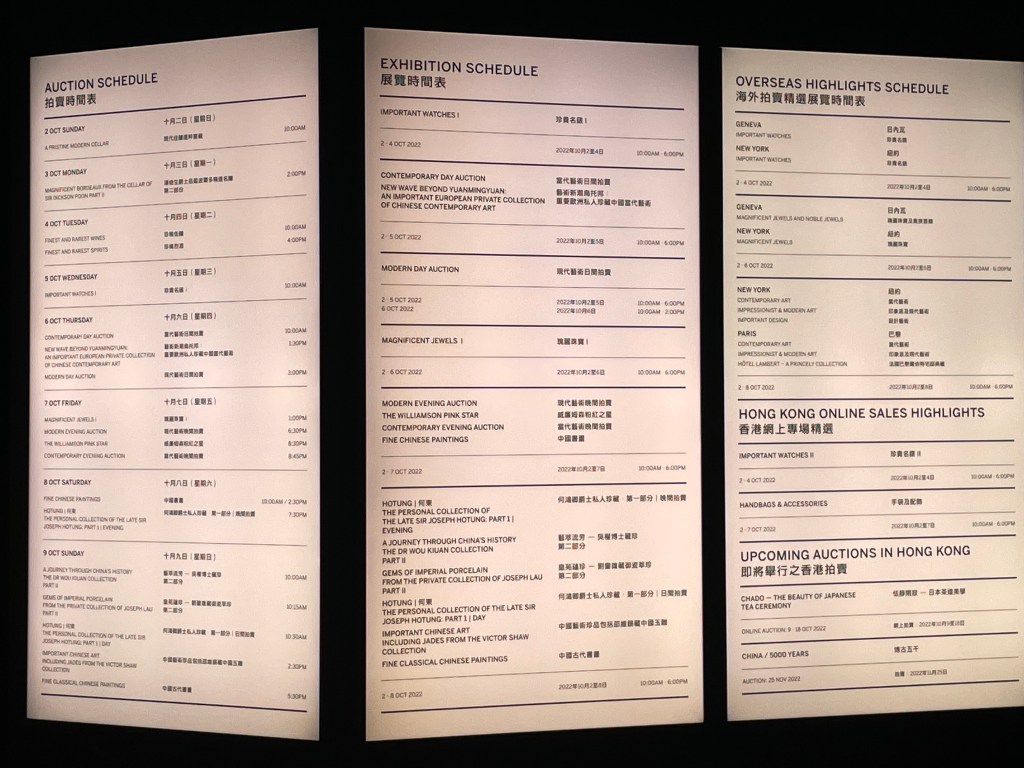
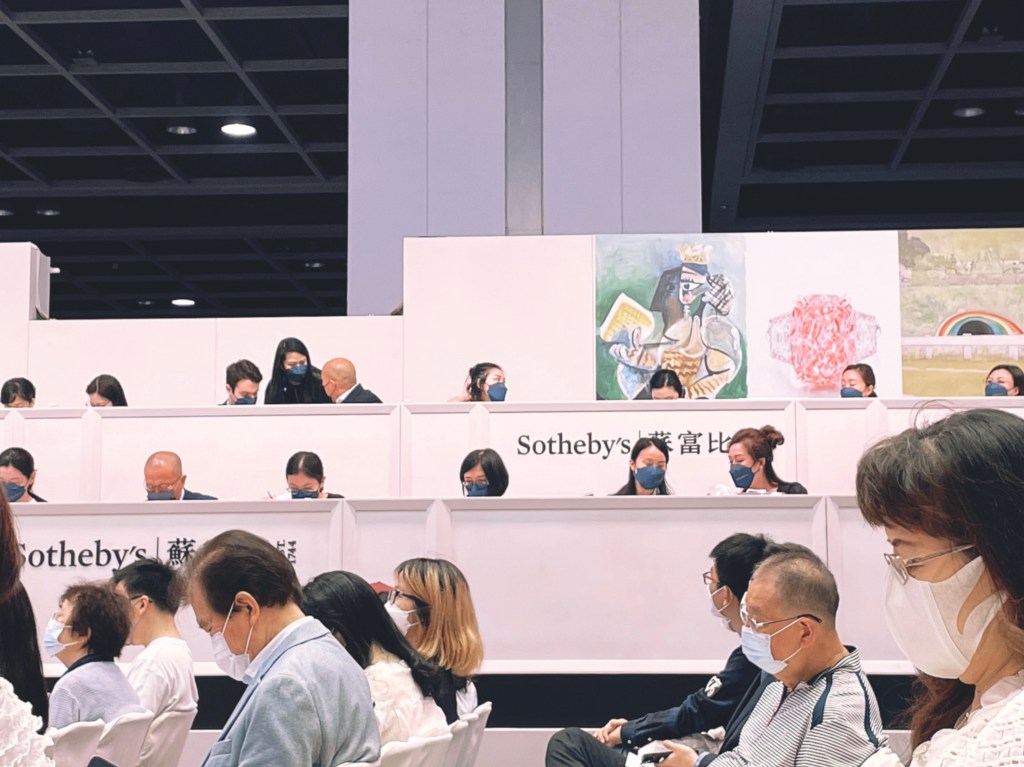
The project conducted a study of the Sotheby’s Autumn Auction 2022 in Hong Kong through a set of ambisonics field recordings. From the first ambisonics of live bidding process in the Chinese Paintings auction, audience can directly recognize the lots from No.3001 to the 3006, with four kinds of people on the site: auctioneers, bidders, and buyers; as well as the awkward artist who was first time at auction and kept adjusting her sitting position; From the second ambisonics of the artist wandering in the auction exhibition, audience can, instead, hear the bidding process to Lot No.3016 in far distance, and the nearby voices of passing visitors talking about the content of the works.
Art auctions are alluring, as they blur the distinction between artwork and commodity. Imagine you wandering in Sotheby’s auction exhibition while hearing the bidding process from the auctioneer, Picasso’s artwork in front of you will no longer 100% reveal its aesthetic character, what is your feeling? To reveal the subtle perception, Nicolas Brown (2019) proposes that in a society whose metabolism is the market, the exchange value of works of art is logically prior as Zweck or purpose. It truly is consistent with the idea of Marx (1976) that in society which appears as an “enormous collection of commodities,” value of a commodity is immediately exchangeable, according to his publication The Commodity. They regard artwork as art commodities in such situations, whose only left character is the value of exchange. That is what auction endues on masterpieces.
However, for the artwork, its commodity character does pose a problem. Without reference to external uses, the Kantian formula for aesthetic judgment should be considered. In Critique of Judgment, Kant (1987) believes that beauty is the form of purposiveness of works of art, as it is perceived therein without the idea of a purpose. He also addresses that in the process of aesthetics, one must eliminate all distractions and desires to achieve the pure beauty of the artwork. Hegel (1970) further developed the idea that the nature of commodities is an actual threat to the internal purpose of art.
That is why the second ambisonics is essential: the artist records an action to break the mono value created by capitalist behavior for the artwork, and address the autonomy of art. As Kant says, the meaning is not only in the artwork itself, but in the subject deciding what status and form to give to the artwork. When visitors wander in the auction exhibition, the beauty of artwork is strongly emphasized in every chat, refusing the position that the distinction between art and commodity has collapsed (Brown, 2019).
Reference
1.Nicolas Brown(2019). Autonomy: The social ontology of art under capitalism. Duke University Press.
2.Immanuel Kant (1987).Critique of Judgment.Hackett Publishing.
3.Karl Marx (1976) The Commodity, New Park Publications.
4.Hegel, G. W. F. (1977) Phenomenology of Spirit ,Oxford University Press.
5.Sotheby’s. (2022, October 4). Wikipedia. Retrieved October 16, 2022, from https://en.wikipedia.org/wiki/Sotheby’s


 Joyce's Gallery