
作者: Joyce
River Talk: A post-colonial inquiry
GE Jingyi
Advisor:Ryo Ikeshiro
BAS in New Media
School of Creative Media Final Year Project


I. Artist Statement
As a prominent metropolis in East Asia, Hong Kong possesses a complex colonial history intertwined with contemporary social transformations. This intricate backdrop has given rise to feelings of confusion and dislocation among the city’s inhabitants, which became particularly pronounced during the zenith of social movements.
Being a Beijing-based artist who witnessed the mass protests in Hong Kong, I have been deeply affected by this collective trauma. Throughout my undergraduate studies, I have dedicated myself to comprehending Hong Kong’s intricacies and engaging with its residents through interviews. Concurrently, I have acquired a wealth of art theories and multimedia creation techniques via coursework, which have informed my artistic endeavors. Following my participation in the summer school, these disparate experiences and insights have coalesced into the nascent framework for my culminating graduation project: “River Talk”, partially collaborating with Yin Ziyuan.
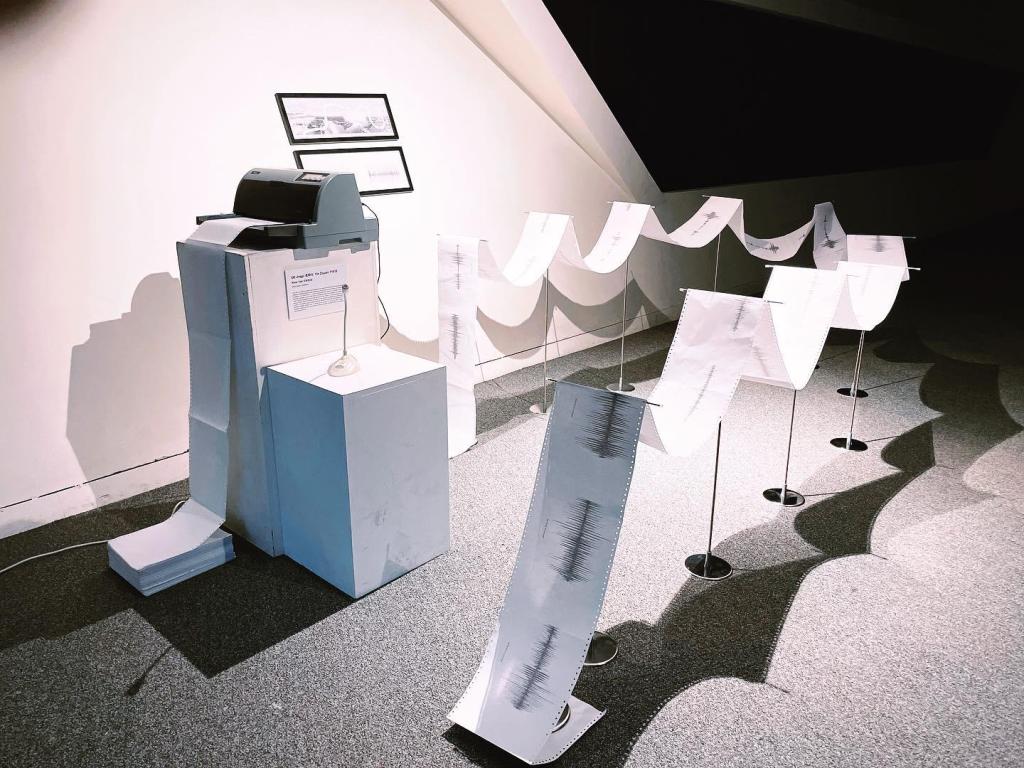
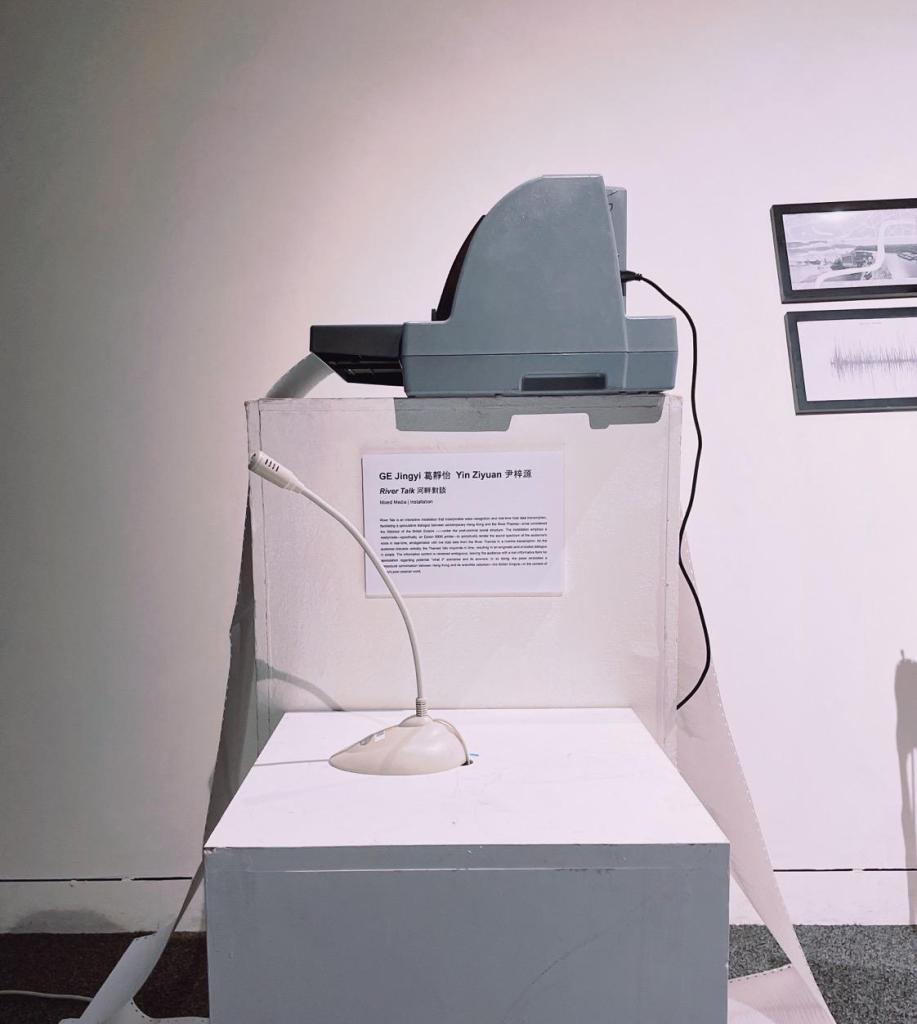
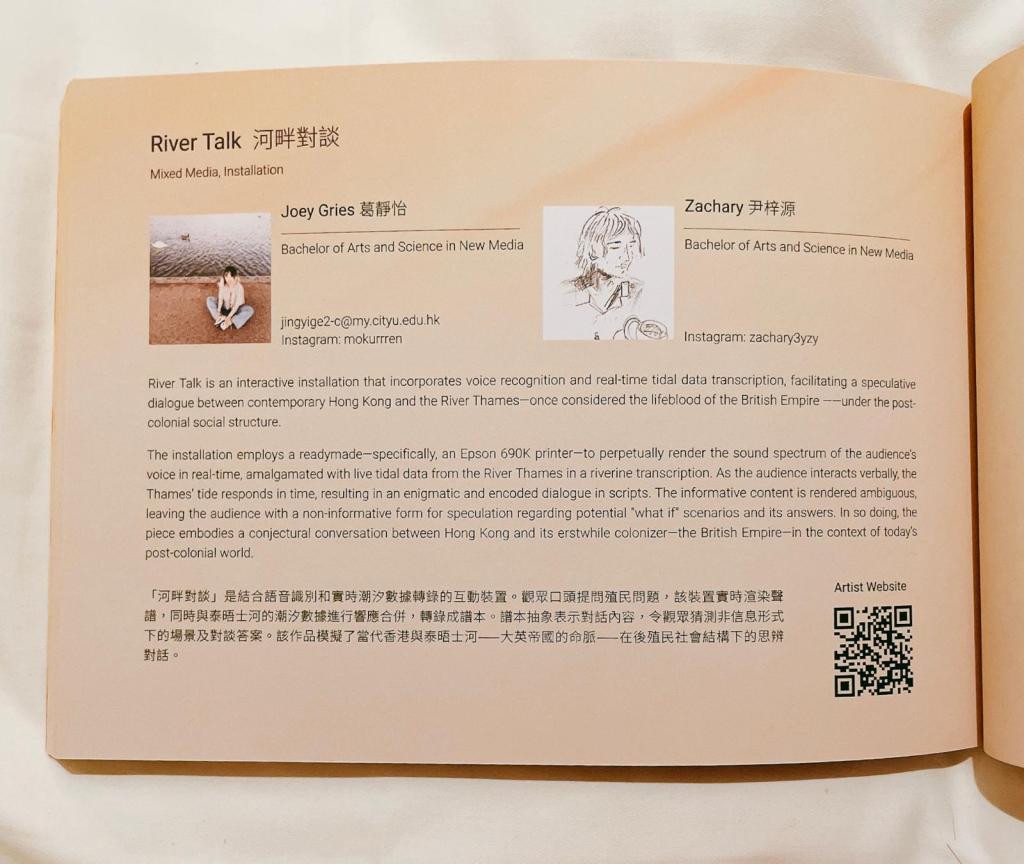
River Talk is an interactive installation that incorporates voice recognition and real-time tidal data transcription, facilitating a speculative dialogue between contemporary Hong Kong and the River Thames—once considered the lifeblood of the British Empire ——under the post-colonial social structure.
The installation employs a readymade—specifically, an Epson 690K printer—to perpetually render the sound spectrum of the audience’s voice in real-time, amalgamated with live tidal data from the River Thames in a riverine transcription. As the audience interacts verbally, the Thames’ tide responds in time, resulting in an enigmatic and encoded dialogue between the two parties. The informative content and the ultimate outcome of this exchange are rendered ambiguous, leaving the audience with a non-informative form for speculation regarding potential “what if” scenarios and its answers. In so doing, the piece embodies a conjectural conversation between Hong Kong and its erstwhile colonizer—the British Empire—in the context of today’s post-colonial world.
II. [RE: VIVAL] SCM ANNUAL SHOW 2023



III. Process
Documentation Video: https://youtu.be/S4QL3vzmkkk
 Final exhibition planning

#倫敦漫記 #後殖民思考 #疫情記憶
忘川之上,桑梓之下
一半是光,一半是影
與Isabelle從泰特英國美術館出來,沿著泰晤士河向東漫步。午後的陽光溫煦,微風輕拂。這是我第一次從一位英國人口中,聽見她對大英帝國殖民時代的真實想法。
Isabelle出身軍人家庭。兒時見到帝國擴張的版圖時,她也曾像所有孩子般驚嘆”大英帝國多麼偉大!”直到後來接觸許多來自苦難國家的人,甚至因英國人身分遭受諷刺——在那些”既得利益者”的指責中,她逐漸明白,那不過是塑造世界形態的一段歷史,談不上榮耀。
我拖著抱恙的身軀勉強回應幾句,她卻彷彿讀懂我的思緒:”我懂人們談及殖民時為何激動,那永遠是傷痛。”虛弱中,我想起香港山頭殘留的港英標誌,街頭激烈的抗爭標語,恍如隔世——這個美麗的世界,是否總將陰霾隨手一拋,便自顧自歲月靜好?但眼前這位西方學者,眼中分明漾著透明的哀傷,她與許多同儕早已開始反思後殖民城市的面貌。
我們談城市規劃、談階級、談雕塑,最終回到她自己。”我正親歷文化歷史如何快速消逝。”她說。當我問及這是否多數英國人的思考方式,她搖頭:”取決於家庭薰陶與個人成長。”鄉間農民可能只讀政府發行的報紙,而她的朋友圈卻常討論這些。這與我的認知如此契合:無論走到哪裡,總有比我更醉心學術的人,也有更耽於享樂的人。知識與愛,或許本無國界。
COVID紀念牆矗立在大本鐘對岸。我們細數疫情初期各國措手不及時的生命逝去。這是政府項目,毗鄰醫院。在溫熱的緬懷中,我看見民眾感謝NHS的留言——危難時節,人們只能將命運託付於更高權力機構。正當我幻想北上廣未來是否會有官方疫情紀念建築時,同行的台灣、巴西、瑞士夥伴卻在質疑為何牆名強調”National”而非”International”。這世界總有人比我更具人文關懷,看見我忽略的稜角。
四點多,大本鐘聲響起。聽說香港殖民時期也曾以此為課鐘。不遠處雖有現代建築,但那哥特式的金色尖塔仍張揚著帝國昔日的榮光。泰晤士河的波光中,我突然恍惚——分不清哪岸才是鏡中城。對岸那些曾令我窒息的沉重命題,此刻竟不如此岸的普世溫情來得真實。或許國與國之間,差的只是時間。
這世界處處有尖銳的社會問題,也處處存在認真生活的人。我自詡比周遭更理想主義,卻也困於自身經驗。終究要親自走過,才明白地球是圓的。
Investigation Note
- Phase I
Making decision: I decide to make an installation related to sound data visualization under the topic of post-colonization;
- Phase I to Phase II
Attempts:
1) I did literature review about the post-colonization
2)gradually narrowed down the scope to recording the sound data from Shing Mun
3) collecting the data and visualizing it via TouchDesigner


Problem: The method of visualization is difficult to grasp. When I tried to extract one frame of the data visualization out to print it as a 3D data sculpture, it was shown that the purpose remained unclear according to my advisor;
Revise: Ryo suggested I do more research about sound data visualization, providing software suggestions like MAX/MSP and speculative methods.

note by 2023 02 15

note by 2023 03 30
- Phase II to Phase III
Attempts:
- Reposition my purpose of making the project,
- More research about sound installation
- Adjust the media to realizing it: Instead of making 3D data sculpture of Shing Mun, I chose to collect the data from both River of Thames and the real-time audio from the audience after the processing of LiBrosa, and try to make an installation, which use Python to control the computer to recognize the audience’s voice and use the real-time data in River of Thames, and finally print it out from an Epson Printer constantly through the control of the computer.
Revise: After getting recognition and the high permission from Ryo, I bought three printers on my own and tried to connect either of them with a computer by Python.
Problem: 1) The creative decision of the combination of spectrum and voice shows an unclear aim, according to Ryo’s reflection
2) Whether sound stream should be included in the project
3) The weak knowledge of python
Revise:
- Need more explanation about the decision
- Decide not to use the sound, after the discussion with Ryo
- Invited another student to collaborate in this project, and learn Python together.
notes
4. By phase III
Attempts:
1) Study and collaborate with Yin Ziyuan (56642636) of Voice Recognition and Data Transcription, by using Python Language
2) Buy facilities needed


3) Coding
Platform: Jupyter
Language: Python
Collaboration : GE Jingyi, Yin Ziyuan

Step1: Get the tidal data in Sheerness from Environment Agency


IV. Exhibition Space for Final Presentation
The installation will be shown at WallE on the 6th floor, CMC.

The installation will use:
1) Laptop (Ready)
2) Printer (Ready)
3) Printing Paper (Ready)
4) Stand (Ready)
5) Power Supply (Ready)
6) Photo Frame (In progress)
7) Table (On the way)

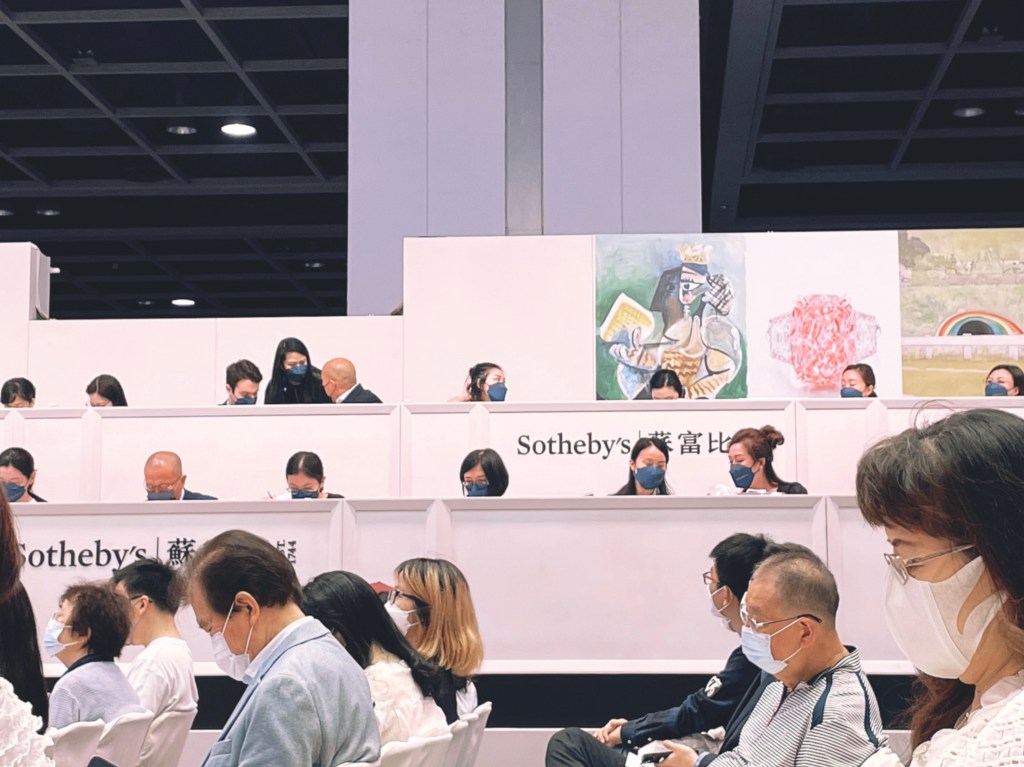
Sotheby’s Autumn Auction 2022 Hong Kong through Ambisonics


Ambisonics Set in Binaural
Written Commentary
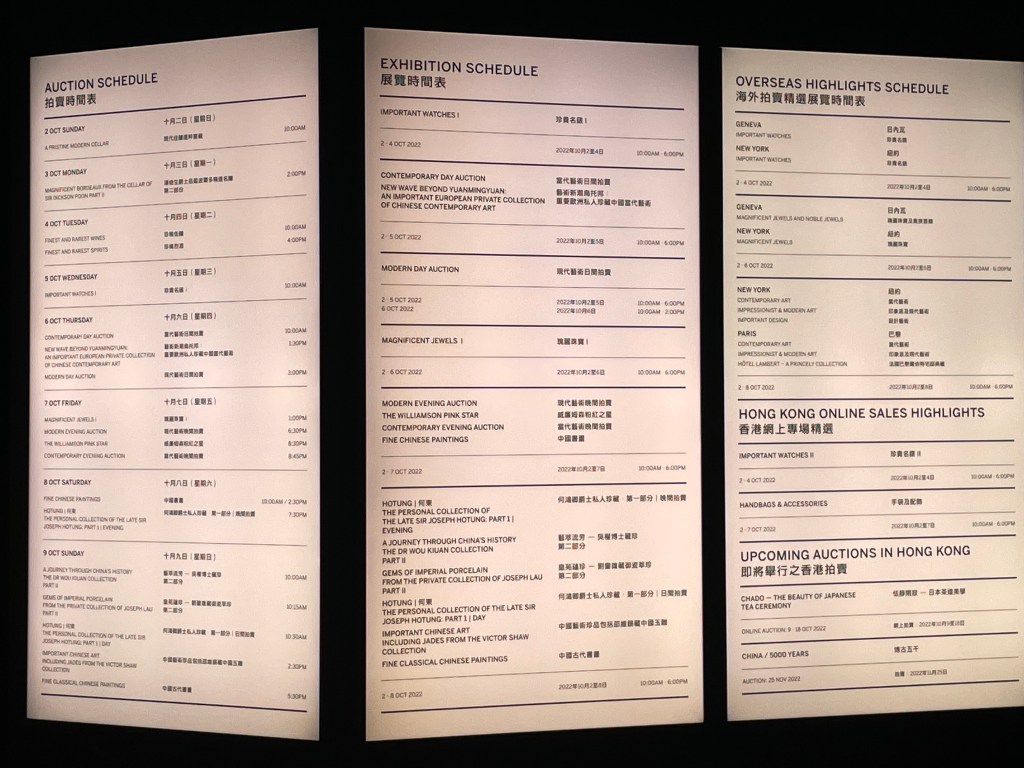
Sotheby’s is one of the largest brokers of art collections. Although it holds auction exhibitions every year, however, ordinary people barely have access to it: once in Asia, only the cities of Hong Kong and Singapore are the qualified locations to hold such events.
The project conducted a study of the Sotheby’s Autumn Auction 2022 in Hong Kong through a set of ambisonics field recordings. From the first ambisonics of live bidding process in the Chinese Paintings auction, audience can directly recognize the lots from No.3001 to the 3006, with four kinds of people on the site: auctioneers, bidders, and buyers; as well as the awkward artist who was first time at auction and kept adjusting her sitting position; From the second ambisonics of the artist wandering in the auction exhibition, audience can, instead, hear the bidding process to Lot No.3016 in far distance, and the nearby voices of passing visitors talking about the content of the works.
Art auctions are alluring, as they blur the distinction between artwork and commodity. Imagine you wandering in Sotheby’s auction exhibition while hearing the bidding process from the auctioneer, Picasso’s artwork in front of you will no longer 100% reveal its aesthetic character, what is your feeling? To reveal the subtle perception, Nicolas Brown (2019) proposes that in a society whose metabolism is the market, the exchange value of works of art is logically prior as Zweck or purpose. It truly is consistent with the idea of Marx (1976) that in society which appears as an “enormous collection of commodities,” value of a commodity is immediately exchangeable, according to his publication The Commodity. They regard artwork as art commodities in such situations, whose only left character is the value of exchange. That is what auction endues on masterpieces.
However, for the artwork, its commodity character does pose a problem. Without reference to external uses, the Kantian formula for aesthetic judgment should be considered. In Critique of Judgment, Kant (1987) believes that beauty is the form of purposiveness of works of art, as it is perceived therein without the idea of a purpose. He also addresses that in the process of aesthetics, one must eliminate all distractions and desires to achieve the pure beauty of the artwork. Hegel (1970) further developed the idea that the nature of commodities is an actual threat to the internal purpose of art.
That is why the second ambisonics is essential: the artist records an action to break the mono value created by capitalist behavior for the artwork, and address the autonomy of art. As Kant says, the meaning is not only in the artwork itself, but in the subject deciding what status and form to give to the artwork. When visitors wander in the auction exhibition, the beauty of artwork is strongly emphasized in every chat, refusing the position that the distinction between art and commodity has collapsed (Brown, 2019).
Reference
1.Nicolas Brown(2019). Autonomy: The social ontology of art under capitalism. Duke University Press.
2.Immanuel Kant (1987).Critique of Judgment.Hackett Publishing.
3.Karl Marx (1976) The Commodity, New Park Publications.
4.Hegel, G. W. F. (1977) Phenomenology of Spirit ,Oxford University Press.
5.Sotheby’s. (2022, October 4). Wikipedia. Retrieved October 16, 2022, from https://en.wikipedia.org/wiki/Sotheby’s


Nestle(v.)
Nestle(v.) is a visual artwork created with TD. It was inspired by the eleventh episode of Fujiwara Ayako-sensei’s InubokuXSecretServants, which tells SouShi’s memory with RinRinCho. RinRinCho, being a sensitive girl, brings him the beautiful emotions of humanity.
“At first I was just imitating her, but it was as if my own nerves were stretching. “
It visualizes the back ground music.
Extractivism_Simulation
Philosophy of entitlement is the cause behind colonization itself, and we are watching the continuation of theft in real-time through practices such as extractivism.
Simpson & Leanne
In this artwork, I use TouchDesigner to simulate the manifestation of the extractivist economy in the colonial period – the process of extracting energy. The whole resembles mineral resources such as mineral stones falling and popping up in an excavated hole.
But the question behind is that we should really think about: what should be the relationship between man and nature? Why we place human above other life forms, holding the belief that taking from the earth will create abundance. Why does it rarely delivers the benefits it promises?Which part of our society has gone wrong?
I have always hoped that humans could live in harmony with nature. Climate warming and melting glaciers have become the biggest threat to lives worldwide. And what benifits extractivism bring to us? In my research I will critically explore this question through the history and practices, and try to explore more possibilities on a philosophical level.
Process

Escape from Chernobyl (ongoing)

College of Design and Innovation, Tongji University Exchange Programme Project
Course: Interactive Information Design
Instructor: Jing CAO
Escape from Chernobyl is an interactive information design group project, using Tableau. The following is the googleslices that can give you the demonstration.
*Escape from Chernobyl will be more complex than this project, by using Tableau to do the deep data analysis and beautification of dashboards.
Design 2D/3D






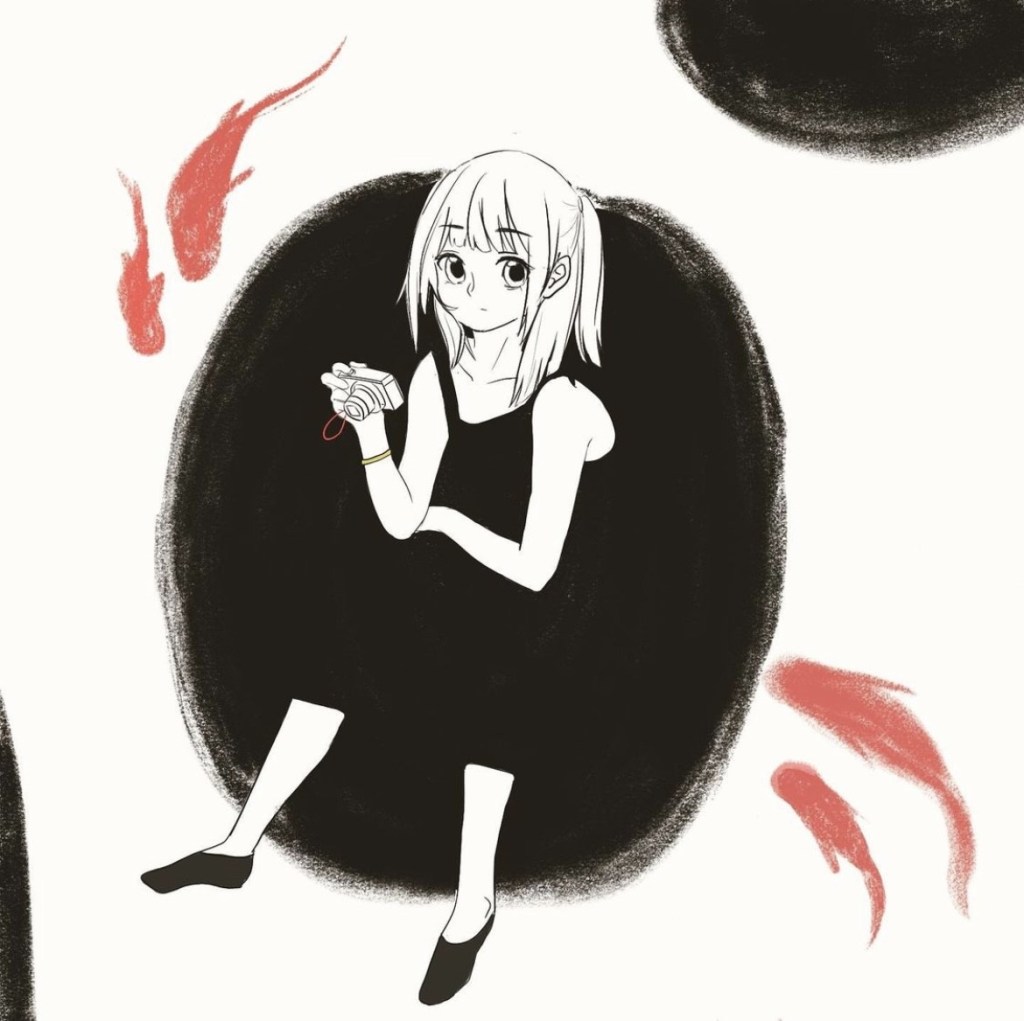





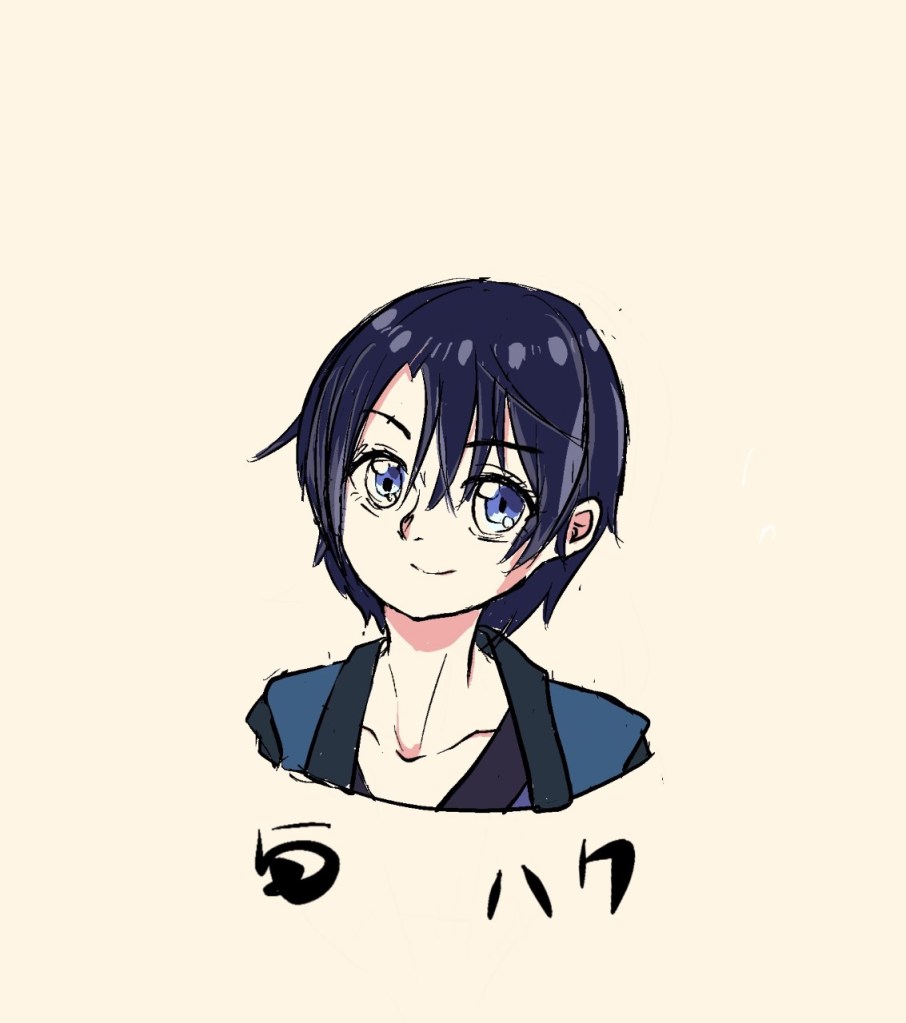


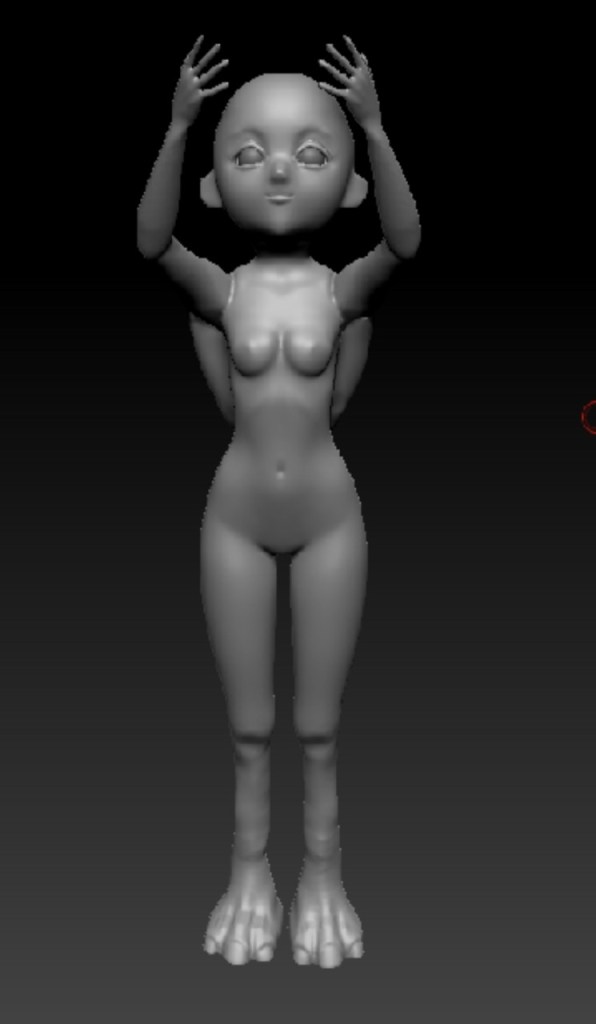


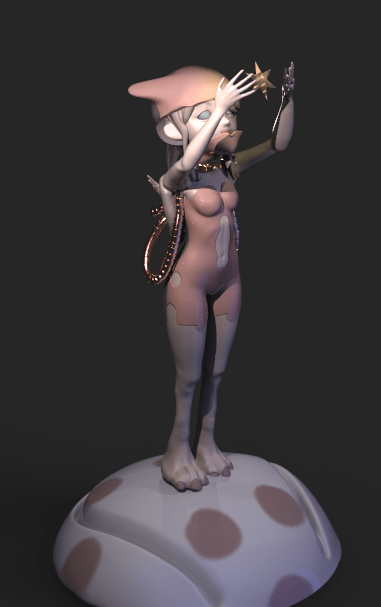
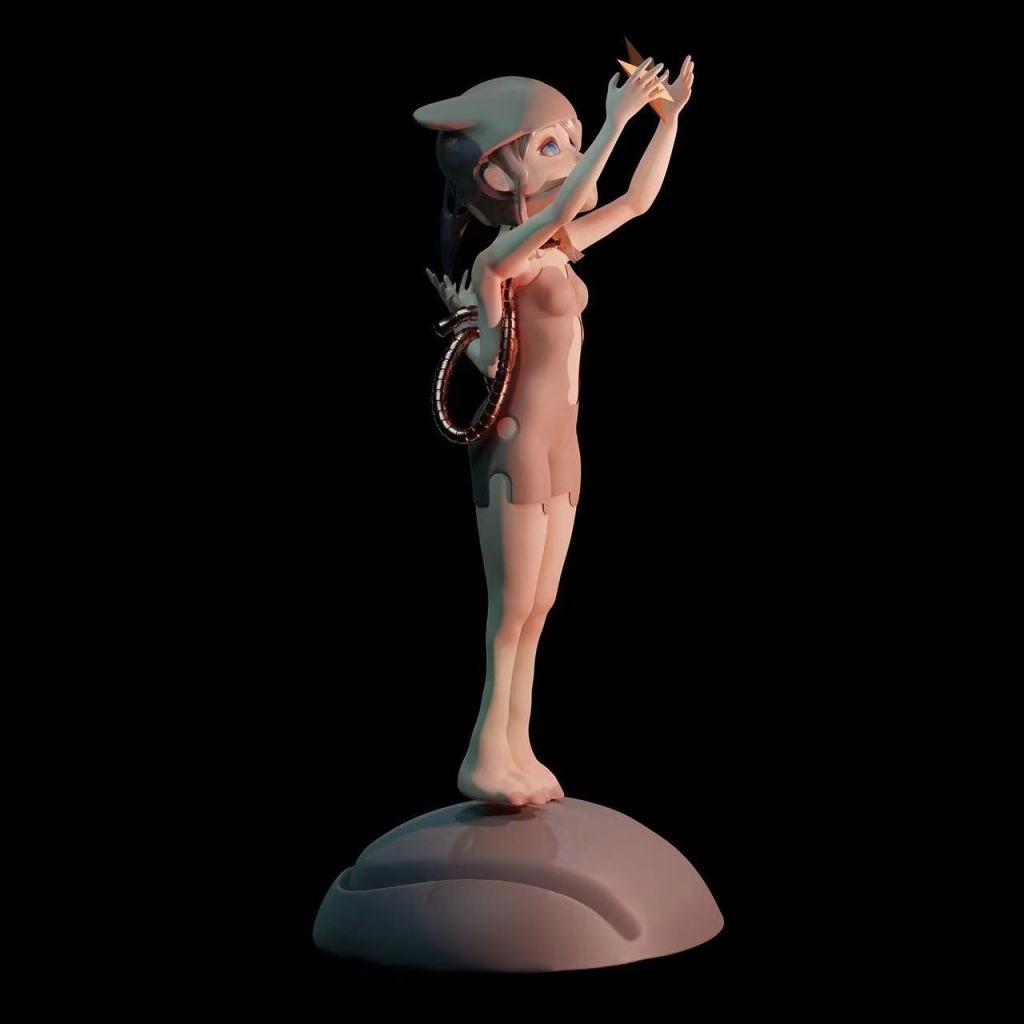
Do(n’t) Say “Future”!
Proposal
The first proposal: 《The Lost City》
At the very beginning, I planned to make a projection mapping pop-up book. But as I searched the Internet, I found my idea has been realized by an influencer on bilibili: https://space.bilibili.com/67969624?from=search&seid=10211234866178864539&spm_id_from=333.337.0.0
Besides, we learnt the slit-scan photography in week8, so I started to think about what I could do by using it.
My 2nd Proposal :《Do(n’t) Say Future!》
Concepts :
The key idea is to show that “How art students become lost when talking about their future “ by using slit-scan technique to human body. Because the whirling effects are good enough to show the lost condition of people.
I want to use this way to criticize the phenomenon that sometimes we go too stressful to achieve our goals in art. And I also want to tell art students that don’t be so hurried, and I call for finding their real dreams and desires.
The project integrates art, science and humanities, because it is a visual short film that has artistic value; and it uses slit-scan technique. This project aims to heal the hearts of art students who are chasing their dreams.
Researches and Related Artists:
Beau Daignault:https://twitter.com/beaudaignault
His whirling/rolling effect is good to show the feeling of lost.
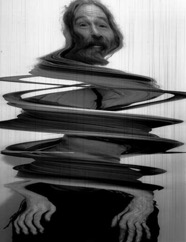
Francois Vogel: https://www.instagram.com/francois.vogel/
He is good at using camera movement to combine with slit-scan technique.

Process
- Recruit people, Shot and Edit
Joyce recruited 14 people to join in this project, and built a Wechat group.
Then they went to these 5 art and design schools to give the performance.

However, there are some difficulties happened:
1.Recruiting People to join in is hard:
–Only half of the people in Wechat group (6 people included me) performed
2.Shooting & Going to 5 schools are Time Consuming:
–But there is the spirit of art performance as well as this project;
3.Editing and making Slit-Scan Effect:
–AE is choppy. It takes 10 minutes to slit-scan a 7-sec footage; CPU got burnt.–> CMC? X
–Shooting other footages/materials to make this video more interesting.
–Airdrop the footages between Ipad & PC back and forth to edit;
–Exporting for 12 times —> Workload
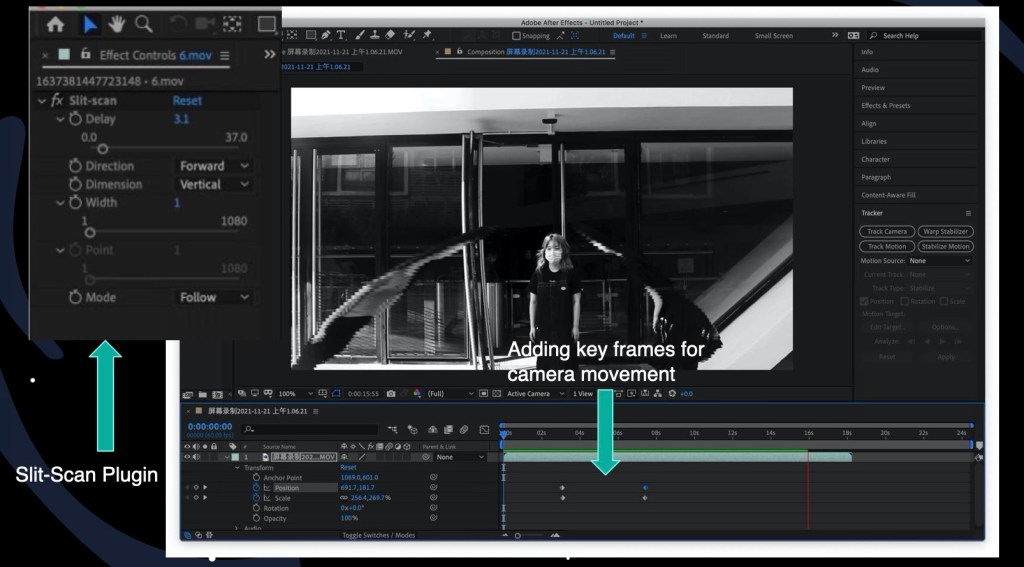
I mainly use the After Effect to made the SlitScan Effect
–First Version Display
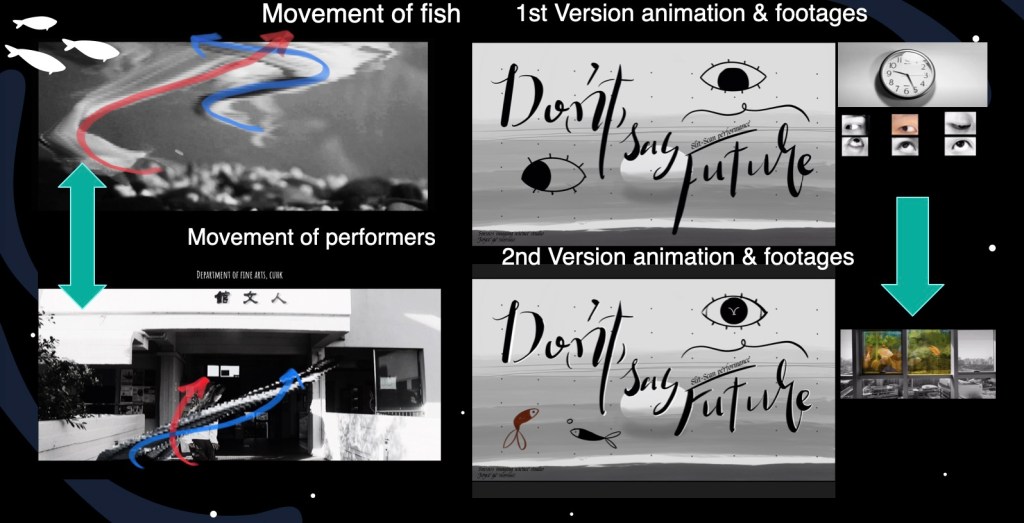
3.After consultation, I decided to add more about the videos of fish that are slit-scanned as us.
You can achieve my presentation powerpoint here:
Do(n’t) Say Future
Do(n’t) Say Future is a short film of slit-scan performance held by art students.
Proposal
Process

Introduce Yourself (Example Post)
This is an example post, originally published as part of Blogging University. Enroll in one of our ten programs, and start your blog right.
You’re going to publish a post today. Don’t worry about how your blog looks. Don’t worry if you haven’t given it a name yet, or you’re feeling overwhelmed. Just click the “New Post” button, and tell us why you’re here.
Why do this?
- Because it gives new readers context. What are you about? Why should they read your blog?
- Because it will help you focus your own ideas about your blog and what you’d like to do with it.
The post can be short or long, a personal intro to your life or a bloggy mission statement, a manifesto for the future or a simple outline of your the types of things you hope to publish.
To help you get started, here are a few questions:
- Why are you blogging publicly, rather than keeping a personal journal?
- What topics do you think you’ll write about?
- Who would you love to connect with via your blog?
- If you blog successfully throughout the next year, what would you hope to have accomplished?
You’re not locked into any of this; one of the wonderful things about blogs is how they constantly evolve as we learn, grow, and interact with one another — but it’s good to know where and why you started, and articulating your goals may just give you a few other post ideas.
Can’t think how to get started? Just write the first thing that pops into your head. Anne Lamott, author of a book on writing we love, says that you need to give yourself permission to write a “crappy first draft”. Anne makes a great point — just start writing, and worry about editing it later.
When you’re ready to publish, give your post three to five tags that describe your blog’s focus — writing, photography, fiction, parenting, food, cars, movies, sports, whatever. These tags will help others who care about your topics find you in the Reader. Make sure one of the tags is “zerotohero,” so other new bloggers can find you, too.
 Joyce's Gallery